





Our collaboration with NVIDIA continues to push the boundaries of AI-powered bioprocess intelligence.
Following our previous work with NVIDIA Nemotron, NVIDIA gave BioRaptor early access to Nemotron 3.5 Super VL ahead of its public release. This allowed us to evaluate the new model on one of the more challenging problems in biopharma: extracting reliable information from executed manufacturing batch records. The model is now publicly available, and below is what we found.
The model has 120 billion total parameters, with 12 billion active during inference. We tested it against a leading frontier vision-language model using real fermentation batch records containing handwritten values, circled options, checkboxes, stamps, and operator sign-offs.
The results
We evaluated 558 fields against human-corrected ground truth.
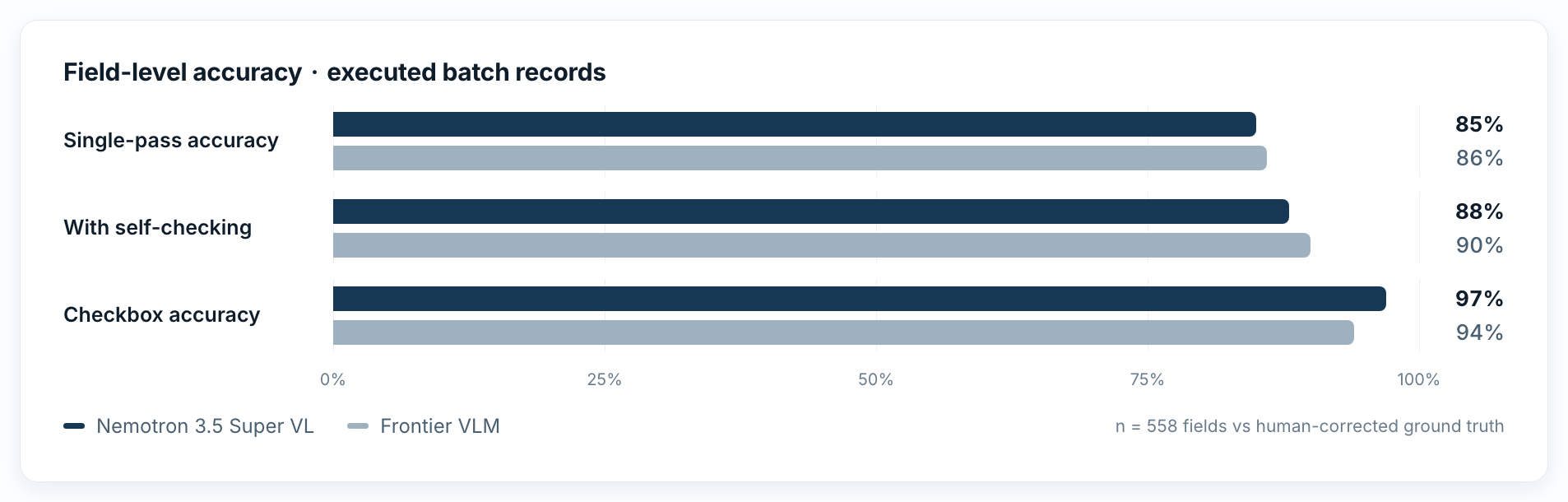
- Single-pass accuracy
Nemotron 3.5 Super VL: 85%. Frontier model: 86%. - With self-checking
Nemotron 3.5 Super VL: 88%. Frontier model: 90%. - Checkbox accuracy
Nemotron 3.5 Super VL: 97%. Frontier model: 94%.
Nemotron also performed better on operator names in document headers and produced fewer hallucinated values.
All of this was achieved without fine-tuning.
What we learned
Our early access allowed us to experiment with different extraction strategies and identify what really matters:
- Reasoning is essential
Disabling reasoning reduced accuracy by more than half. - Simple instructions make a difference
Rules for interpreting handwriting, circled selections, and units improved extraction without customer-specific training. - Give the model room to reason
A 64K-token output budget proved useful. - More context isn’t necessarily better
Providing example images actually reduced accuracy.
Achieving a better combination of accuracy, cost, and privacy

For the test, we ran the model on two GPUs, on AWS using spot instances with costs at approximately $0.003 per page, amounting to around 1/6 of the frontier API cost in our evaluation.
Irrespective of costs, for biomanufacturing, where the process is much of the secret sauce, there is an added benefit: the model can run entirely inside a customer’s own cloud environment (VPC). Sensitive batch records never need to leave that environment for an external model API.
From batch records to process intelligence
At BioRaptor, document extraction is only the beginning. Extracted values are validated against a bioprocess schema, reviewed by users, and connected to sensor data, offline measurements, materials, and process outcomes.
This turns information buried in manufacturing records into structured data scientists can use to investigate variability, compare runs, and improve processes.
Our continued collaboration with NVIDIA helps us bring increasingly capable AI models into practical biopharma workflows, combining frontier-level performance with the control and economics needed for real-world deployment.
If you would like to see batch-record extraction on your own records, book a demo with us and we’ll show you what’s possible.

