


.png)
.png)
By Yaron David, Ronen Talmon and Asaf Ben-Arie
Process development forces high-impact decisions from limited data. Which media, which feed strategy, which inoculum conditions and set points are most likely to improve yield, productivity and robustness? The honest answer, most of the time, is that nobody knows until the runs come back.
Why brute force doesn't scale
The parameter space is too large to search by running experiments. Even a moderate number of media variants, feed settings and inoculation strategies produces an experimental design that is too large, too slow and too expensive to execute. And the process is dynamic: the final outcome depends not only on initial set points but on environmental effects, feeding protocol, inherent control cascade and human decisions made mid-run. A useful model has to account for both the experimental settings and the time-dependent behavior.
Why purely data-driven models don't either
The obvious alternative is to learn from the runs you already have. But bioprocess datasets are typically small, heterogeneous and unevenly distributed across the parameter space. Some regions are well represented; others have few or no examples. Standard predictive models struggle to generalize reliably beyond the specific runs they have already seen.
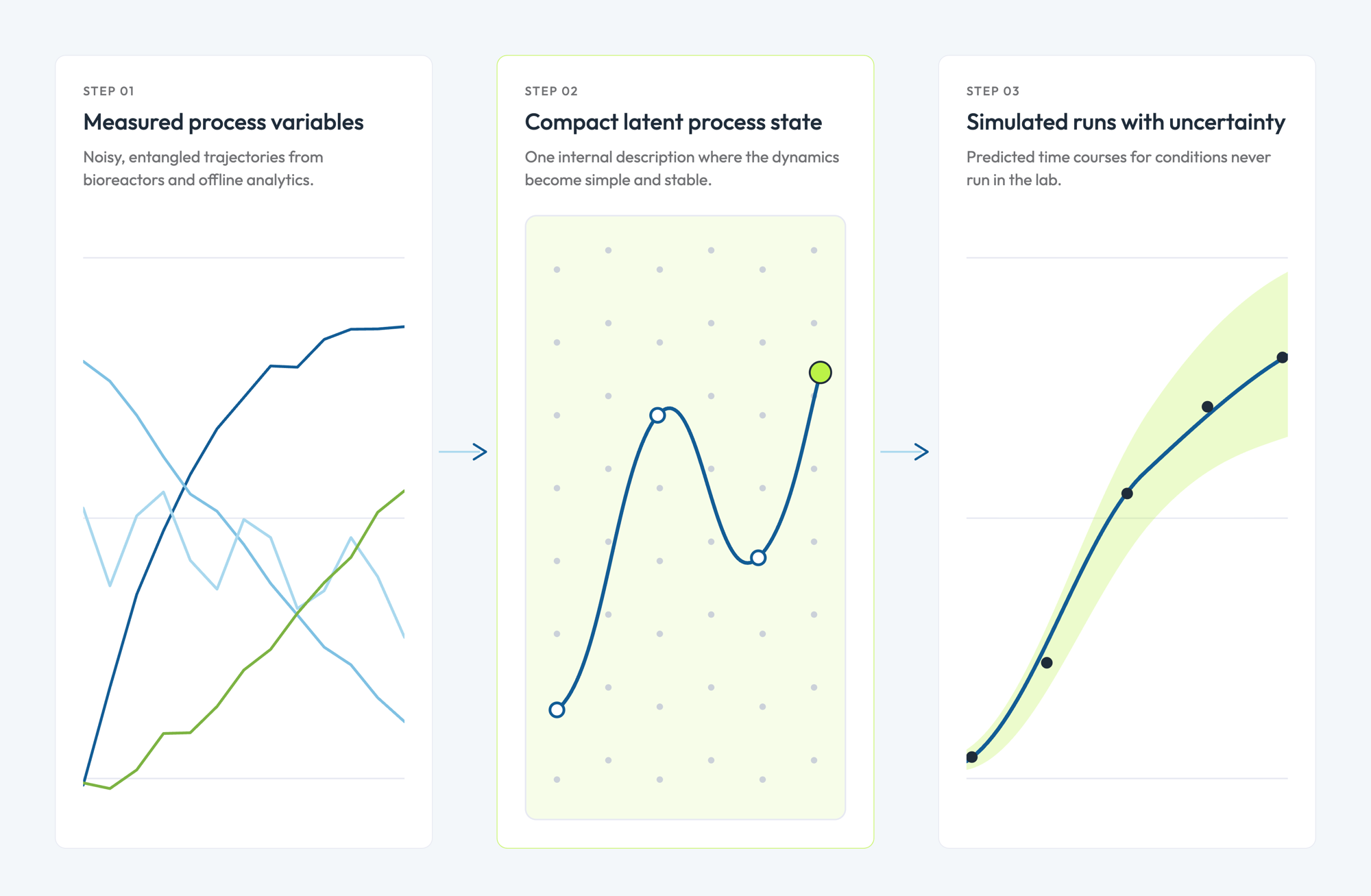
There is a second difficulty. Raw process measurements — glucose, lactate, ammonia, VCD, product concentration — are complex, noisy and entangled. They are not independent variables; they reflect an underlying biological and operational state. Learning dynamics directly in that raw measurement space would require far more data than process development usually has.
Learning the state, then learning how it moves
Our approach combines two ideas. Representation learning converts complex process trajectories into a compact internal description — a “process state” that captures the major patterns shared across runs while filtering out noise and redundancy. Dynamics learning models how that internal state evolves over time.
Representation alone isn't enough. A static embedding may group similar observations together without explaining how a run moves from one state to the next, or how early behavior influences final yield. Learning the two jointly is what makes the model useful for control and optimization.
What you can do with it
Once trained, the model acts as a digital twin. Given only the planned set points for a run, it simulates the expected time evolution of key process variables — growth, metabolites, volume, product concentration — before the experiment exists. Predicted trajectories can be compared against historical runs and their confidence bands, so the model's reasoning stays inspectable rather than opaque.
That changes how a design-of-experiments gets built. Instead of selecting experiments by intuition or broad factorial coverage, you can evaluate many candidate settings computationally, prioritize the designs predicted to improve a target attribute, and take a smaller set forward to the bench. The model also flags uncertain regions of the design space — where more data would actually be valuable — which helps avoid low-value runs.
Read the full paper
The whitepaper covers the modeling framework in detail, including the dataset it was trained on — historical fed-batch CHO runs spanning 5–500 L — and worked examples of predicted trajectories.

